Showing posts with label Sentosa. Show all posts

Saturday, May 30, 2009

What we've been up to in May

Whew! What a crazy month!

During the weekend of 24-25 May, the Crabs were at the Envirofest event (at Toa Payoh Hub) together with nearly everyone else from the active nature conservation community of Singapore.


Nature lovers were out in full force to share their work with the members of the public. Doing an exhibition is as important as doing field work. It gives us a platform to reach out to the masses with our message of conservation. Saving habitats, giving a voice to the animals that we try so hard to save cannot be the work of a few individuals in a community. We have to share what we have learnt in all our field trips with ordinary folks. They may not joined us in our field trips but many are no less concerned with issues of nature conservation in Singapore. They are the ones teaching their own children, students, sharing with friends and family. Every effort counts.

Saturday, December 13, 2008

First Sentosa walk of December

The omnipresent threat of rain from an overcast sky failed to dampen the enthusiasm of our young visitors on Friday's Sentosa Shore Walk, our first for the month of December. The preparations for ZoukOut the next day also failed to distract our visitors from the rich and abundant wildlife of Sentosa's shores, although our hunter-seeker for the day, Ivan, had partying on his mind. LK, November and myself each took one group of visitors.

Thankfully, no rain fell and we were able to end our shore walk safe and sound (and mostly dry above the knee), but not before getting a chance to get to see some of the shore dwellers close-up.

Cheryl and the gastropods.

Wednesday, July 9, 2008

Sentosa Walk 6 July 2008

A turnout of 30 visitors greeted us for our last Sentosa walk of this current season. Lovely weather was guaranteed for our visitors, from the looks of the fair skies that morning.

In fact, before the morning light even penetrated the skies, Kok Sheng and his friend had been hard at work doing hunter-seeking and getting the stations ready for our visitors.

Ivan and Gerald’s group went down to the shore first, while LK and Vyna’s group waited for more people to come. Some of our visitors had fallen victim to the “meeting point doppelganger”, so do remember to park at the nearest car park which is located at Imbiah walk, not Imbiah Lookout.

The first treat for the visitors before they reached the shore was the sight of the natural rock formation which does look like mini-caves. We marvelled at the pink rocks, the result of the presence of oxidised iron. One of our young visitors asked if there were bears inside. Well, no bears for sure – but you will definitely be spoiled by the presence of a rich variety of marine life! LK also explained about the harsh environment that these trees above the rocks survived in.


We soon went down to our first station, where the visitors got to see a mosaic crab, a brown egg crab and a small shrimp. At the second station, they saw flatworms, a red egg crab and nudibranch species such as the Phyllid, Jorunna funebris and Phyllodesmium briareum. Most nudibranchs are carnivores, and feed on immobile creatures like barnacles, sponges, ascidians, hard corals, soft corals, sea anemones, zoanthids, peacock anemones, sea pens and eggs of other creatures including other nudibranch eggs even!


Despite all that variety, the humble (and fortunately still rather common) hairy crab which was scuttling amongst the rocks, almost stole the show. Our young visitors thought that the “teddy bear” crabs were extremely cute!

We took our visitors to the station where the black sea cucumber (Holothuria leucospilota) was found. Our group were amazed looking at the sea cucumber which tensed up when it was touched, but relaxes and appeared to grow longer when it was let go (however, visitors should not touch anything on the shores, leave it to the more experienced guides please!). Sometimes, it may even squirt its sticky threads out when it is distressed!

Plenty of the soft ‘omelette’ corals were out in full glory, some even displaying their polyps prettily being half-immersed in the water.


Not to be outdone, the hard corals, such as the mushroom coral below, also make their presence felt. Why mushroom? When they are young, these corals are attached to some surface by a stalk, which they grew out of and detach from when they grow larger. And don’t the patterns on the mushroom coral match resemble very much the underside of a mushroom?


The variety of marine life on the Sentosa shores astounds even the guides. At one of the stations, we saw a sponge moving – or rather, a crab which looks like a sponge! Can you spot it in the picture below?


The tide was coming in, and our last station was at the tidal pool. Remember folks, take nothing from the shore but only pictures! See here one of our young visitors exercising his own “Independence Day”, releasing the marine life he had seen earlier back into the sea.


At the end of the Sentosa walk, the participants gathered at the end point and drew lovely drawings to depict what they have seen for the day. They also got to know more about how glasses protect our eyes from UV rays by using the indicators cards provided by Transitions Optical, sponsor of the Naked Hermit Crab Sentosa walks!


Everyone had a great time at the walk. See the broad smiles on everyone!


Thanks to the guides who made the walk successful: Ivan, LK, Jerald, Allen, Vyna, Kok Sheng and his friend. Credits also go to LK for many of the pictures on today’s post.

Sunday, June 22, 2008

Sentosa walk 22-June-08

While everyone was sleeping in on this Sunday morning, the Crabs led a small group of people out on the natural shore at Sentosa. Because of the stormy weather, less than half of the people came today. The inclement weather was just horrendous. It poured and poured, and lightning was everywhere.

(No, we are not that crazy! We don't go out to the open shore when there is lightning. The guides will show up at the appointed place and time, but we will sit and wait for the weather to clear.)

That's H and CH with their bright ponchos outside the cafe, checking the weather.
While LK chatted with the Neo family to find out more about what they expect to see on the shore.


Finally the weather cleared, off we went!


R led a group of Chinese students and they were wonderfully enthusiastic about the trip! They were excited to see many of the common animals on Sentosa's natural shores such as hard corals, soft corals and even sponges which come in such a wide variety of shapes and colours. The picture above showed a magnificent giant soft coral with mushroom coral and sponges around it.

We also talked about seagrasses and the many kinds of seaweeds.

The 3 kids in LK's group were equally excited to see the little brown egg crab, 2 tiny hairy crabs and some of the snails. They now understand that the brown egg crab is poisonous. The kids asked about the black sea cucumber (they read our blog lah!), but we did not see any today.
Because the China students were science students, the Crabs could go all out and explain things like chemical defences, zooxanthallae, impact of carbon dioxide and acid oceans, and other fascinating concepts which seemed to interest them too.

Here they are taking a closer look at the large acropora hard coral which is a rather rare hard coral on our shores.

Overall the students asked really good questions like "there seems to be a complete food chain on the shore, so what is the top predator?". To which of course we had to sadly say most of the top predators in a natural food chain have been affected by development. In natural circumstances, top predators such as otters and large fishes such as groupers would probably be more common on our Sentosa shores.
CH and H found nudis! Wow. And CH explained the delightful properties of these amazing creatures.
And here is the unusual nudibranch. There were 2 of them in fact. And when CH and H found them, they were 'hanging around' the seagrasses. This particular nudibranch, Phyllodesmium briareum, feeds on soft corals. It also contains symbiotic zooxantellae that makes food and thus supply nutrients to the animal.
It continued to drizzle and when the rain got heavier again, we returned to shore. But everyone was glad to have an introduction to the marine bio-diversity found on Sentosa.
Here's a little bit more information about the wonderful group of China students who came today. They will be starting their undergraduate studies in July but had arrived in Singapore last December to start on their bridging course. They are a bunch of bright happy kids. They told us that they are trying to adapt to the Singapore environment, soaking in all that is good and not-so-good about Singapore - the climate, culture, society and food.


They came to know about our nature walks through the Lianhe Zaobao article last Monday. From the article, they found it hard to believe that there are so many unique marine creatures on Singapore shores. Animals that they only saw on TV documentary programmes! In a way, I guess the newspaper report opened their eyes to the natural beauty of Singapore, and I am sure they will go in search of the same natural beauty when they return to their homeland.

LX who booked this trip with us explained that he comes from an island, that is about the same size as Singapore, located in the Zhejiang province. In his words, he wrote, "A few years ago, it was the largest fishery port in China. Because of years of excessive fishing, the marine resources decreased. So we took many measures to protect our environment, such as prohibition of fishing during certain mouths. And it works."

We're really happy to have brought the students and the Neo family out on the shore. We wish you "Happy nature exploring!"
Total number of visitors today = 12
Total number of guides = 4 (Ria, LK, CH and Helen)

Thursday, June 12, 2008

Sentosa goes Naked!

On 9 June 2008, we went out on our favourite Sentosa shore with 30 visitors as part of our birthday celebrations. Here's a lovely group photo taken just before we went down. It was 8:30 am, but everyone was raring to go!


And so we did....

Among the first sign of life on the beach was this large hole made by the Ghost Crab. The reason it is called a Ghost Crab is because few people ever really see it. It is a very fast-moving crab with excellent eyesight and it runs off even before you can get a glimpse of it.
And so, July drew on the sand, explaining how the Ghost Crab forms a Y-shaped tunnel with 2 holes, and how it so cleverly hides from intruders.

As many of you know, the part of Sentosa where we explore is also a coral reef. A hard coral of this size, over a metre in diameter, takes forever to grow. I'm pretty sure this living coral is older than half of all our participants at the walk.
If there are hard corals, then there are soft corals too! Here is one, not too big, but it has polyps with green tips. One of our visitors asked if such corals glow in the dark. I'm not an expert in this, but my guess is that it does.
I was absolutely thrilled to see the beautiful and very large patch of Dead Man's Fingers, a soft coral that is found on many of our southern isles. What an eerie name, but the coral is spectacular. We stood there admiring it for quite a while.


Closer to the rocky shore area, we found lots of the Black Sea Cucumber (Holothuria leucospilota). These long black sea cucumbers are commonly seen on our southern shores. They usually hide under rocks or among the coral reef area. They have a mouth and an anus.


We will also thrilled to see a large school of juvenile catfishes darting around our feet. These catfishes can grow quite big, up to a metre long. They spend the early part of their lives in safe lagoons such as this one. Please don't handle any catfishes as some of them have venomous spines on their dorsal and pectoral fins. It will be one big painful experience if you were stung by one.
I am unfamiliar with this and am waiting for someone to help me id this. It has long tentacles and a beautiful reddish brown colour.

The next 4 photographs give you a good general idea of the conditions during a shore walk. We stopped endless times to see the animals in their natural environment.
The long Tape Sea Grass in the foreground is commonly found on Sentosa shores. In general, sea grasses are a good bio-indicator of the condition of a shore. There is another group of volunteers, called Team Seagrass, who monitor the different species of seagrasses in Singapore. Several of the Naked Hermit Crabs volunteer with them too.
Here is a lovely mother and son team, admiring a soft coral.
Exploring ...
Admiring.... not collecting anything.... just taking photos .... writing notes....
Before we knew it, it was time to end the walk. Hard to believe that we spent 2 hours on the shores.

On our way up, we found a small troop of Long-tailed Macaques foraging on the shores. In the wild, these monkeys are very resourceful and will know how to feed themselves with all kinds of interesting things. That is why we constantly remind friends and visitors that we should never feed the macaques in our forests. Feeding them changes their natural behaviour. Sometimes it changes their palates too.
The peacock couldn't resist the action either and was seen foraging on the sandy beach.
After the long walk, we were all tired out. The Crabs whipped out their construction papers and magic pens. Visitors were game and obliged us with some lovely drawings (another post, lah!)

As we were not in a hurry, we mingled with the groups for a longer time than normal. We even found time to explain about UV rays using the UV indicator card given by Transitions Optical, sponsor of this series of Sentosa walks. The kids were interested and began testing their mom's sunglasses on the card. To read more about UV rays, the invisible enemy, check out the Transitions Optical site.

Thanks to all our enthusiastic vistors for making this a wonderful day of nature exploration. Now that you've seen the beauty of the natural shores, go and talk about it with your friends and families. Be the eyes and voice of our natural heritage!

Thanks to all the guides, many of whom took leave to do this, for your passion. Present today were July, Haliah, Gaytri, November, Ivan, Jerald and LK.

Thanks too to Transitions Optical for sponsorship (the walks are free!)

Friday, June 6, 2008

Happy Birthday Naked Hermit Crabs!

There’s no better way to celebrate our first birthday than to be out exploring on the shores and sharing them with a group of wide-eyed bushey-tailed kids (and their parents!) on 6-June-08.

It was one of the lowest spring tides in the annual calendar and we knew there would be so much to see.


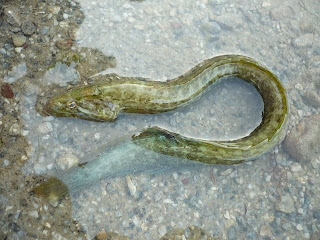
The first creature that James and Bian found was the carpet eel blenny (Congrogadus subducens). I thought it was spelt ‘blarney’, haha, I was wrong. It has an olive-green body with dorsal fins going all the way to the back and joined to the tail fin. The poor fellow was stranded as the tide receded but luckily it managed to find a small pool of water. We left the eel where it was and went on in search of other sightings.


We were delighted to find a pair of Coastal Horseshoe Crabs (Tachypleus gigas). This species is listed as vulnerable due to its reduced populations as a result of pollution and loss of habitats. There are two species of horseshoe crabs in Singapore. The larger coastal horseshoe crabs is distinguished by its large grey shell and triangular serrated tail while the smaller mangrove horseshoe crab, which we often see at Chek Jawa, is brownish with a rounded (cross-section) tail.
Here are 2 picture of them doing the kind of stuff that horseshoe crabs do in nature. The kids asked me if the tails are stings. Well, they are not stings. The tail of the horseshoe crab helps to upright itself if it should accidentally flip over. With its legs shorter than its large shell, the horseshoe crab needs a prop to help it flip back up. How interesting! (Hey! Don’t you go flipping horseshoe crabs to test this. I’m sure you wouldn’t like it one bit if someone flips you over all the time).


There is truly life on the rocks. There are lots of snails, with and without shells on the tidal rocks. The top picture is of a nerite with a lovely orange-grey colour combination. The bottom picture is an onchidium, which we all call the "onch" with much affection. The "onch" does not have a shell, but its tough leathery flesh is well-camouflaged among the crevices of rocks.


Bian spotted a beautiful hard coral that was half submerged (picture above). So we were able to see the polyps blooming below the water, while the polyps above the water line have all retracted into the coral. It was a perfect live specimen to show to the kids.

The kids were mesmerized when we showed them the mushroom coral (Family: Fungidae). It is a free-standing hard coral unlike the majority of hard corals which grow on some kind of surface. Baby mushroom corals start off with a stalk on some hard surface but as they grow larger, they detach themselves from the stalk.

Isn't this the Red Egg Crab? It has found itself a perfect hiding place under the giant tyre (I’m amazed by the kinds of trash we can find on our shores).

Actually there is no need for the red egg crab (Atergatis integerrimus) to hide. It is a poisonous crab and should not be eaten. Its bright colour serves as a warning signal to other marine animals, the red colour screams “Hey I am poisonous! Eat me if you dare!”

As for us human beings, it always pays to learn more about our local marine wildlife. That’s why the Naked Hermit Crabs believe in sharing this knowledge and we do this through our nature walks for the public.


Here is a close-up photo of the zoanthids or colonial anemones found in the large tidal pool, one of my favourite spots in the Sentosa shore. I often find myself drawn to this spot and could spend a long time here admiring the beautiful colours of the zoanthids and trying to count the different animal species. Zoanthids live in colonies like corals do, but they do not form a hard skeleton.

And here is a photo (taken in 2007) of the same tidal pool.


And here is a photo of Ivan and his group after the walk.

It was indeed a lovely day out. What a privilege for us to spend a wonderful morning amongst the natural beauty that some of these unspoilt beaches still offer to ordinary people like you and me.

Our heartfelt thanks to our wonderful and enthusiastic visitors for joining us on our birthday nature walk. Maybe we don’t say it often enough, but your sense of wonder and child-like curiosity keep our hearts light and our passion glowing. Thank you!

Lastly, thanks go out to fellow Crabs – Haliah, Vyna, Bian, James, July and Ivan – for their time and effort for yet another successful Sentosa walk!

Some of the kids who came to this 6-June-08 walk also blogged of their experience:
Matthew's blog

And July blogged too.....
Note: This nature walk is provided free to our visitors because of the kind sponsorship by Transitions Optical. Thanks, Transition Optical, for your encouragement!

Tuesday, May 27, 2008

Announcing our Sentosa Walks 2008

If you have been following our blog, you will know that the Naked Hermit Crabs is one year-old this June. In fact our inaugural walk took place at Sentosa on 5 June 2007!

Time flies. It is also a wonderful feeling to be one year-old and the satisfaction of having done something good for the wild and threatened shores of Singapore!


Hey, we’re celebrating and what better way than to go back to where it all began for us. Sentosa! Mark these dates.

6-June (Friday) - we had a great trip out!
9-June (Monday) - sorry, we are full!
6-July (Sunday) - sorry, we are full!

Let’s make it a double celebration. 5 June is World Environment Day! Join us in our mission to showcase the diverse marine life and natural beauty on our shores. We will bring you on a mini adventure to a beautiful natural shore tucked away in a corner of Sentosa. There will be lots to see. Just read our old blogs on Sentosa.


However we do need you to register for these walks. Write to us at our email address (nakedhermitcrabs@gmail.com) and let us have the following information:

- Name of contact person
- Telephone number
- Preferred date(s) of walk
- Number of people in the group and their age

Meeting place and time = we will inform you when we confirm your attendance through e-mail. The walks are in the morning.

Do take note that we DO NOT accept walk-in’s at our Sentosa walks. Sorry about that.

Triple Celebration!

Now for more good news. You will be happy to hear this. We used to charge $5 per person for our Sentosa walks. But this year, the Sentosa walks organized by the Naked Hermits Crabs are sponsored by Transitions Optical. So the Sentosa walks are FREE this time round!

Transitions Optical, world leader in the manufacturing of plastic photochromic lenses, have spent the last few years educating the public about the dangers of UV rays and the need for protection of our eyes. Thus, it is fitting that Transitions Optical support our passion of protecting the wild shores of Singapore. We are delighted with this financial and moral support provided to us.

Please read on for Some Really Useful Information:

Why is the group size small?

Because we want you to have an enjoyable trip! When the group is small, you can hear the guide’s explanation and see the specimens better. We are also concerned about excessive trampling on the precious animals that we are showing you. We want minimal impact on the fragile shore as far as possible!

Is this walk suitable for the very old and the very young?

The answer is No. But it is suitable for kids in K1 and K2, and of course for our seniors who are fit and active.

Why can’t I sign up for 50 people from my company?

The Naked Hermit Crabs are small and …. well… naked. We are sorry, but we can only handle small family and friends groups of up to 6 people right now.

How to get to Sentosa:

Nearest MRT station is Harbourfront
You will be able to board buses and the Sentosa Express.
Cars and taxis are allowed to enter Sentosa, but not motorcycles.
More details on the Sentosa website.

Entrance fees to Sentosa:

While our walks are free, you will have to pay your own entrance fees to the island.
$3 per person for entry by bus/monorail, inclusive of free use of Sentosa bus and rail within Sentosa all day.
$2 per person for entry by car/taxi. In addition, there is a $2 charge per car.
More details on the Sentosa website.


What to prepare for the walk?

Wear covered sports shoes. Diving booties are ideal. Don’t wear your very old shoes. We’ve had lots of visitors whose shoes gave up on them halfway and they had much difficulty with the trip after that (not to mention, the danger of getting cuts). Make sure your footwear still have good traction as we may need to step over some slippery rocks at some point.

Please know that open sandals and slippers are NOT suitable. For your own safety, we will not allow you to take part in the nature walk if you do not wear covered shoes.

Wear lightweight clothes, preferably sportswear or outdoor wear. Long pants are good for protection against scrapes and sand fly bites.

Wear a hat. Wear sunblock. Wear your protective eyewear. Hey, do you know … Transitions Optical lenses block 100% of UV! That’s cool!

Bring drinking water and a light snack.

Bring a change of footwear to go home. Your shoes will get wet.

Keep your backpack light as you will need to carry it with you during the walk.


We look forward to meeting you real soon!

AddThis